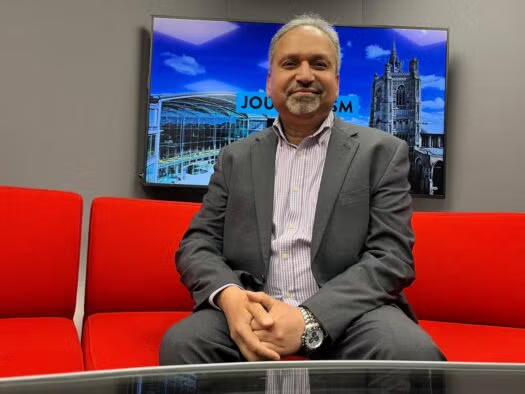
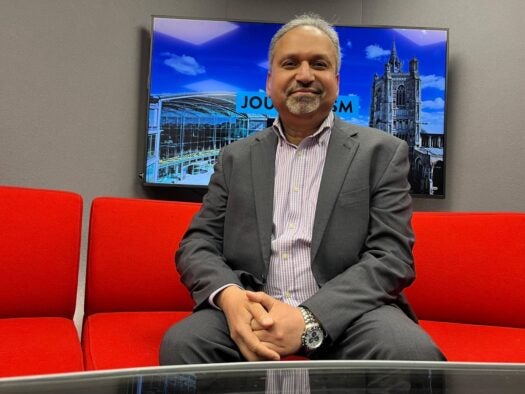
Former BBC journalist and British Journalism Award nominee Barnie Choudhury has been hit with charges of £14,270.70 by the appointments body for judges following a dispute over FOI requests.
The Judicial Appointments Commission (JAC), an independent body responsible for selecting candidates for judicial office in England and Wales, said Choudhury “acted unreasonably” in pursuing enforcement action after it failed to comply with a tribunal order to disclose information requested in an FOI.
Since 2020, Choudhury has written 23 investigative articles for Eastern Eye in his campaign against judicial secrecy, alleging bullying, misogyny and misconduct in the judicial appointments process.
After threatening the JAC with Contempt of Court, Choudhury’s reporting successfully led to the JAC disclosing confidential recruitment materials and exposed the body for its unlawful use of FOI exemptions.
His long-running campaign against the JAC led to stories on topics including calls for a senior official for JAC, accused of misleading a court, to be questioned again and claims of bullying within the judiciary.
Choudhury was shortlisted for the Public Service Journalism award at the British Journalism Awards in 2025 for his work.
He withdrew his Contempt of Court Action against the JAC in September 2025 once he had enough information to continue reporting, “even though the JAC had not fully complied with the decision notice”, he said.
In October, the JAC filed a costs application against Choudhury, arguing he “acted unreasonably in making and pursuing the application”. He is due to appear before a London tribunal on 29 April.
Choudury no longer writing because of mental toll
Choudhury told Press Gazette the case has taken a personal toll, adding he is no longer writing because “it’s had such a bad mental effect” on him. His last article for Eastern Eye was published on 26 March 2026.
“They decided that they would apply for costs against me because they said I was being unreasonable, and they have no proof of that… what it is is a threat against journalists, and if they win, it’ll be a chilling effect, because it’ll stop [journalists] taking on the judiciary and holding power to account,” Choudhury said.
“Nobody scrutinises the money that the Judicial Appointments Commission uses to fight court cases. They’ve got shedloads of public money… without any oversight, because the government says that we have an independent judiciary…
“What’s the best way to shut down a journalist? Legal them, threaten them with legal stuff because newspapers like mine won’t be able to afford it.”
Choudhury added the JAC’s application is flawed and unfair, and he had acted “reasonably and transparently throughout”.
The case has raised concerns at the National Union of Journalists (NUJ), which warned of threats to media freedom and a SLAPP-style intimidation of journalists.
[Read more: National newspaper editors unite to demand anti-SLAPP law]
SLAPPs, or Strategic Lawsuits Against Public Participation, are lawsuits targeting journalists, news organisations, whistleblowers or other groups publishing information in the public interest that are widely regarded as meritless, abusive and aimed at bullying them into silence.
Laura Davison, NUJ general secretary, said the JAC’s move to recover costs in this way is “highly unusual” and warned of wider consequences if the application succeeds.
“If the JAC’s application is upheld, it would create a significant new risk for journalists using FOI requests to hold power to account and add to the weaponry of those who use SLAPPs to silence media scrutiny,” she said.
Davison urged the JAC to reconsider its position.
A spokesperson for the JAC said: “These costs were the result of a case brought by Professor Choudhury, not the JAC. They are only for the costs incurred of responding to an application for JAC to be certified for contempt, and that application was withdrawn.
“As a public body, we are required to be responsible with taxpayers’ money and this may include recovering funds from individuals who incur costs in line with normal tribunal rules.
“We do not comment on ongoing litigation and will await the outcome.”
Choudhury has encouraged journalists to observe the upcoming hearing online, which takes place before the First-tier Tribunal (General Regulatory Chamber). Further details are available by contacting campaigns@nuj.org.uk.
The post Judges body hits journalist with £14k costs bill for pursuing FOI request appeared first on Press Gazette.