News publishers have disputed a claim from Google that using their content to “fine-tune” its AI models contains “no realistic prospect of harm” to them.
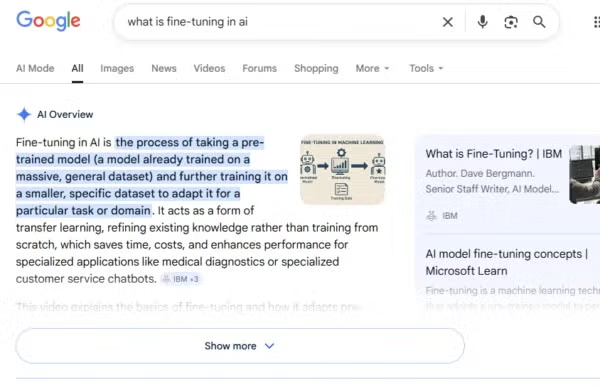
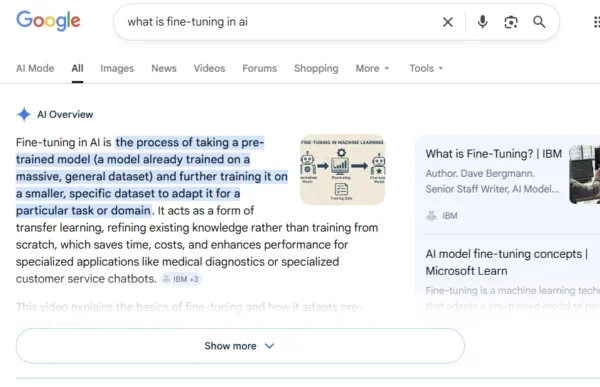
‘Fine-tuning’ enables an AI model that has already been trained to add new data to respond to a specific prompt or task.
Google told the UK’s Competition and Markets Authority that there is “no realistic prospect of harm to publishers in respect of training/fine-tuning of AI models for search and search generative AI features.
“Fine-tuning helps the model learn how to process information rather than what current information to display; this internal processing does not create a substitute for publisher websites. A model relying solely on patterns learned during training would be static, often outdated, and prone to hallucinations.”
The CMA has said it is not minded to provide separate controls for fine-tuning but publishers asked it to reconsider.
The CMA has published responses from several major news organisations to its consultation relating to proposed conduct requirements to be imposed on Google under new powers in the Digital Markets, Competition and Consumers Act 2024.
Guardian Media Group said in response to Google’s position that it “demonstrates the clear value of publisher content at every stage: training, fine-tuning, and grounding – but in particular in keeping outputs accurate.
“Given that news publishers are trusted sources across a wide range of queries, this would suggest that their content is being used to create substitutional products – invalidating the argument that it causes ‘no harm’ to publishers.”
The Guardian argued there is a “trend towards more frequent, bespoke fine-tuning to improve model accuracy, the impact of which is to improve the recency of underlying LLMs, i.e. their ability to include current information in their responses.
“This in turn risks devaluation of emerging and valuable RAG markets for news content.”
The publishers argued that Google should be told to use separate crawlers and opt-out controls for different AI purposes including training, RAG (retrieval augmented generation,the process through which generative AI models retrieve and reference new information from the web in real time) and fine-tuning so content owners can choose which ones to opt into.
Daily Mail, Metro and The i Paper publisher DMG Media told the CMA: “Any advantage Google gains by bundling its fine-tuning crawler to its search rankings is an unfair competitive advantage not enjoyed by other AI companies… we strongly suspect Google could isolate fine-tuning without impacting its ranking algorithms were it not commercially incentivised to refuse to do so.”
DMG also said it expects Google to “rely more and more on fine-tuning rather than grounding. Google could well simply rely on frequent or continuous fine-tuning in a manner that effectively replicates grounding.
“Where publishers have decided not to opt in for use of their content for grounding for search generative AI features, the effectiveness of that would be significantly undermined if Google could fine-tune its models so frequently it no longer needed to ground its models to the same extent.”
The Financial Times said publishers “must be able to exercise distinct, granular controls over different uses of IP, including grounding, training, and fine-tuning” at both directory and page level.
“Bundled or imprecise controls would significantly weaken our autonomy and ability to negotiate effectively,” the FT said. This point was also argued by the News Media Association, which represents UK national and regional news publishers.
The NMA suggested that if Google is not forced to separate out fine-tuning, new requirements telling it to attribute the source of content in products like AI Overviews and AI Mode “will incentivise them not to use grounding to surface specific content and instead rely on fine-tuning to avoid negotiations over payment and ensure that users stay within Google’s services”.
US trade association News/Media Alliance said: “Publishers should be provided with the right to opt out of fine-tuning in all instances. The benefit of doing so would be to ensure that Google does not reap the value of publishers’ content for bolstering a service that is the single biggest threat to the sustainability of high-quality journalism.
“Google’s arguments regarding the importance of fine-tuning for the quality of Google’s products, services, and features highlights the value publisher content adds to Google’s services.
“Google admits that fine-tuning is used for ‘text generation’ and not just ranking. Given this value proposition, there should be a fair exchange of value. Google should not be allowed to take publisher content simply because it is convenient and it has traditionally done so.”
Echoing the concerns about fine-tuning replacing grounding/RAG, the News/Media Alliance said: “If Google’s models are continuously and regularly fine-tuned using publisher content, this may undermine the use cases for real-time access for grounding, reducing publishers’ ability to license their content for RAG purposes and undermining any grounding controls provided to publishers.
“In addition, by making the information stored in the models fulsome and up-to-date (again, through deliberate copying of journalistic content), finetuned outputs are more likely to negatively affect clickthrough rates to publisher properties, while keeping readers within Google’s walled garden. As a result, publishers must be given the ability to opt out of generative AI fine-tuning without negatively impacting their rankings in organic search results.”
Publishers urge CMA not to wait a year for payment-for-content decision
The CMA said in January it will “wait for 12 months to see the impact of our initial measures before deciding whether to take further action in ensuring [publishers] receive fair and reasonable terms for their content”.
DMG Media urged the CMA to develop a “payment-for-content” conduct requirement for Google now rather than waiting a year.
The News Media Association described this delay as a “significant gap” and said it is “disappointing” that the CMA has not recognised that creating “fair and reasonable terms… is essential to directly address a long-established imbalance in bargaining power between Google and news publishers.
“That imbalance has constrained publishers’ ability to negotiate fair terms for the value their content brings to Search services, with direct implications for the financial sustainability of UK news publishing.
“Addressing this imbalance would support investment in journalism, with clear consumer benefits of increased quality and plurality of news.”
The CMA said Google should “take reasonable steps to ensure” content is sufficiently and accurately attributed in AI Overviews and AI Mode.
But the CMA has been urged by the News Media Association to ensure Google provides not only sufficient attribution but “prominent” links “designed to encourage user engagement with original sources”.
DMG Media said that “at a minimum” Google should be forced to “state any attribution should be in close proximity to the content and have appropriate prominence and visibility”.
Publishers are frequently blindsided by major algorithm changes. DMG Media said there should be “explicit and binding” minimum notice periods for changes to how content is ranked, suggesting one month for routine changes and six months for major ones.
The Independent suggested Google should provide a “clear description of the purpose and focus of the update, and how it will change the experience for users”, the types of content or behaviours being targeted, the anticipated impact on ranking dynamics and content surfacing, and any recommended actions publishers should consider at least 30 days before a core algorithm update is implemented.
“Advance notice is critical to allow publishers to assess risk, mitigate potential disruption to revenue, and ensure continuity of service for users,” the title said.
Publishers ‘lost upwards of £1m a year’ due to Google site reputation abuse policy
DMG Media also specifically called for Google to be forced to reverse its site reputation abuse policy, first implemented in 2024.
The policy penalised websites that were paid to host third-party content like coupons, editorial sports
betting, lottery, and gaming content. The News/Media Alliance noted that this type of content “provides valuable resources to millions of consumers”.
The group said that as a result some of its members had “significant and long-standing sections of their web properties or, in some cases, their entire websites de-ranked, in at least one case effectively eliminating Google referral traffic and resulting in 75 percent drop in total reader traffic overnight”.
DMG Media, describing itself as a “victim of Google’s arbitrarily applied ranking policies”, said: “This was an arbitrary policy which immediately reduced a valuable revenue source to zero.
“The result has been that users are no longer given guidance from search results for answers to questions such as ‘what are the best washing machines’. Instead, they are more likely to ask AI Mode or AI Overviews, which may well have been Google’s intention.”
One anonymised publisher told the CMA that it estimates the impact of the policy as more than £1m per year.
The CMA proposed that Google should introduce a new complaints procedure to allow publishers to raise concerns over the impact of such changes on them when they argue it is unfair.
DMG Media said the CMA should instead “include an explicit prohibition or clear requirement to withdraw the policy, rather than relying solely on a lengthy and uncertain ex post complaints process”.
The post UK publishers urge CMA to curb Google as search giant claims AI does them no harm appeared first on Press Gazette.