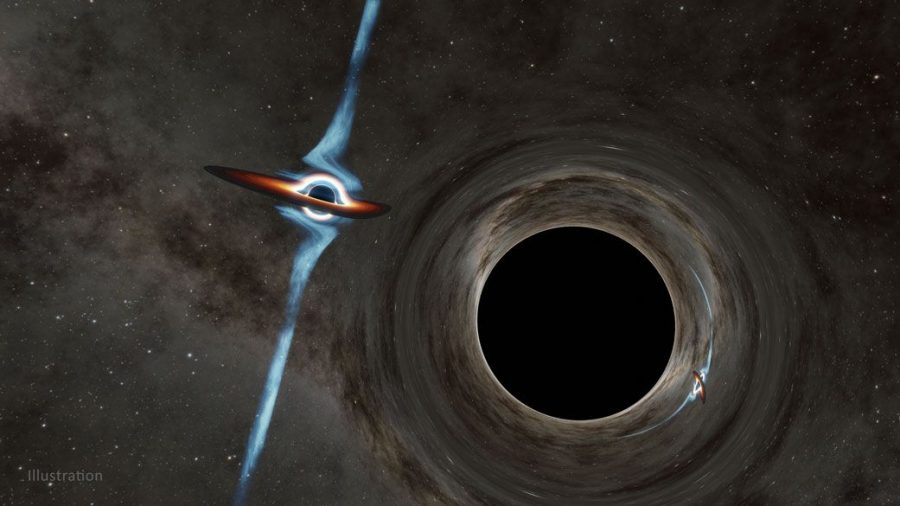
Astronomers and astrophysicists have long been puzzled by the existence of a peculiar class of black holes that defy conventional understanding. These enigmatic objects are too massive to have formed from the remains of a single star, yet they fall short of being classified as the supermassive black holes that dominate the centers of galaxies. Now, new research has uncovered compelling evidence that sheds light on their origins, offering a groundbreaking explanation for these so-called ‘impossible’ black holes.
What Are ‘Impossible’ Black Holes?
Black holes are typically categorized into three main types: stellar-mass black holes, which form after massive stars collapse; intermediate-mass black holes, which are relatively rare; and supermassive black holes, which can weigh billions of times the mass of our Sun. The ‘impossible’ black holes fall into the intermediate category and have long been a cosmic conundrum. With masses ranging between 100 to 100,000 times that of the Sun, they are far too large to have formed from a single star’s death but much smaller than their supermassive cousins.
Scientists have struggled to explain how such black holes come into existence, as their formation mechanisms appeared to be absent in previous astrophysical models. This has led researchers to dub them ‘impossible’ due to their seemingly inexplicable origins.
New Evidence Points to Stellar Collisions
Recent studies have provided an answer to this mystery: the formation of intermediate-mass black holes could be the result of a series of stellar collisions within densely packed star clusters. When stars in such environments collide and merge, they create increasingly massive objects. Over time, these merged stars can undergo gravitational collapse, forming a black hole with a mass that places it squarely within the intermediate range.
This theory has received strong support from computer simulations and observational data. Researchers used advanced computational models to simulate the dynamics of star clusters, finding that collisions between stars are far more common in dense clusters than previously thought. As these collisions accumulate, the resulting objects become massive enough to collapse into intermediate-mass black holes.
Implications for Our Understanding of the Universe
Understanding the origins of intermediate-mass black holes has profound implications for our broader knowledge of the universe. These celestial objects may serve as the missing link in the evolutionary chain of black holes, bridging the gap between stellar-mass and supermassive black holes. Furthermore, their formation process provides new insights into the extreme dynamics of star clusters and the role of gravitational interactions in shaping the cosmos.
Intermediate-mass black holes also play a critical role in the formation of supermassive black holes. Scientists believe that these ‘impossible’ black holes could serve as the building blocks for their larger counterparts, merging over time to create the titanic structures that anchor galaxies, including our own Milky Way.
Future Research and Exploration
While the latest findings represent a significant breakthrough, many questions remain. For instance, scientists are keen to understand the exact conditions under which stellar collisions occur and how frequently they lead to the formation of intermediate-mass black holes. Upcoming missions, such as the Laser Interferometer Space Antenna (LISA), are expected to provide new data by detecting gravitational waves from black hole mergers, offering further clues about the life cycle of these mysterious objects.
As technology advances and our observational capabilities improve, the study of intermediate-mass black holes promises to yield even more fascinating discoveries. For now, one thing is certain: the universe is far more complex—and awe-inspiring—than we ever imagined.