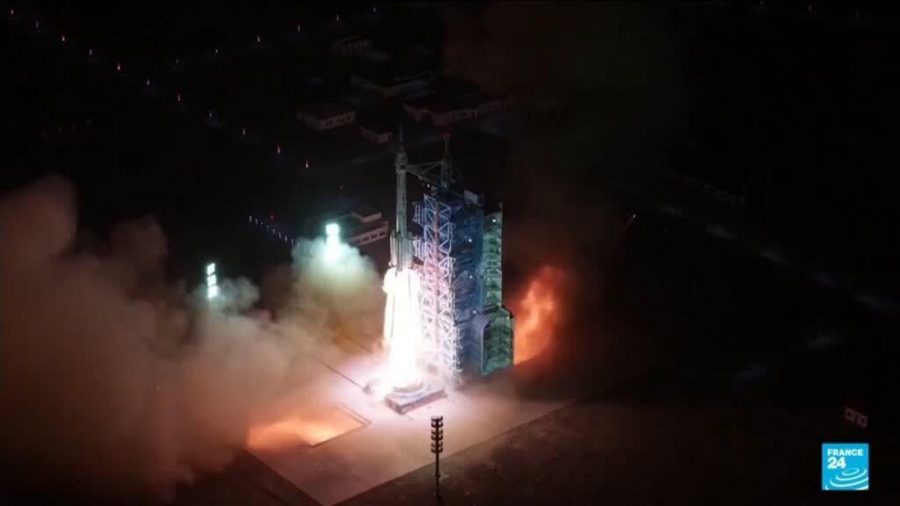
China has taken another giant leap in its ambitious space exploration program with the successful launch and docking of the Shenzhou 23 spacecraft to the Tiangong Space Station. This milestone marks a critical step in the nation’s long-term plans to establish a strong foothold in space, including preparations for future lunar landings and extended human spaceflights.
Shenzhou 23: A New Chapter in China’s Space Program
The Shenzhou 23 mission, launched from the Jiuquan Satellite Launch Center, carries a crew of three astronauts who are set to embark on a series of groundbreaking tasks during their time aboard the Tiangong Space Station. The spacecraft docked seamlessly with the station, showcasing China’s growing expertise in space technology and operations.
The mission’s objectives are multifaceted, ranging from preparing for China’s first human lunar landings to conducting advanced scientific experiments in zero gravity. The crew will also undertake China’s inaugural year-long stay in orbit, a significant endurance test designed to gather critical data on the long-term effects of space travel on the human body.
Steps Toward Lunar Exploration
One of the mission’s primary goals is to lay the groundwork for China’s future lunar exploration program. The astronauts will be tasked with testing life-support systems, evaluating equipment durability, and simulating scenarios that could arise during a Moon mission. These efforts are all part of China’s broader strategy to land astronauts on the Moon by 2030, a timeline that places the nation in direct competition with NASA’s Artemis program and other international lunar initiatives.
China has already made significant strides in lunar exploration with its Chang’e series of robotic missions, including the historic Chang’e 4 rover, which became the first spacecraft to land on the far side of the Moon. The Shenzhou 23 mission builds upon this legacy by focusing on the human aspect of lunar exploration.
Scientific Discovery and Long-Duration Spaceflight
In addition to lunar preparations, the Shenzhou 23 team will conduct cutting-edge experiments in fields such as materials science, biology, and astronomy. These experiments aim to leverage the unique conditions of microgravity to advance scientific knowledge and innovation.
Notably, the mission includes China’s first planned year-long stay in orbit, a feat that few nations have attempted. This extended mission will help researchers study the physical and psychological challenges of prolonged space travel, a crucial aspect of future missions to the Moon and beyond.
China’s Growing Role in Space Exploration
The Shenzhou 23 mission underscores China’s rapid progress in a domain once dominated by the United States and Russia. The Tiangong Space Station, now fully operational, serves as a symbol of China’s determination to become a global leader in space exploration. With plans to expand the station and collaborate with international partners, China is positioning itself as a major player in the new space race.
As the mission unfolds, all eyes will be on the Shenzhou 23 crew and their groundbreaking work. Their efforts not only pave the way for China’s lunar ambitions but also contribute to humanity’s broader quest to explore and understand the cosmos.