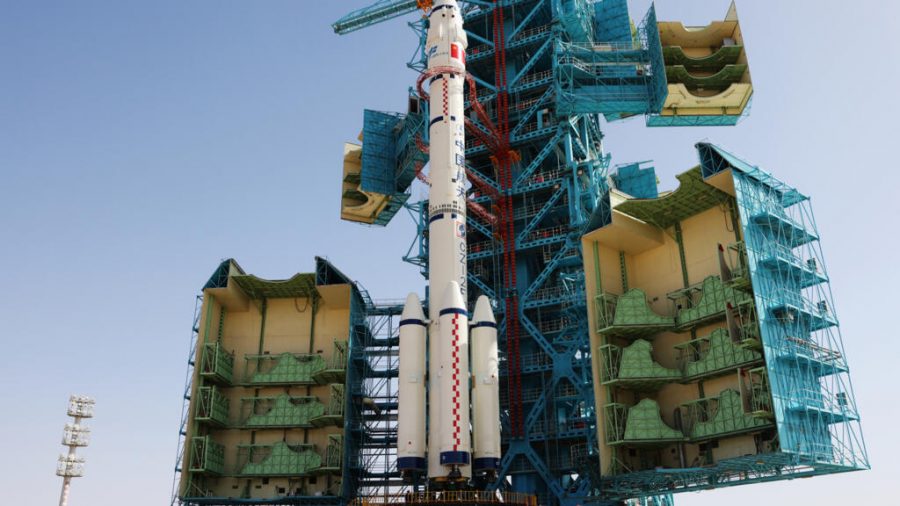
China Takes Giant Leap in Space Exploration
China launched a historic three-man space flight to its Tiangong space station on Sunday, marking a significant milestone in the country’s ambitious space program. The mission, which will see one astronaut spend a full year in orbit, is a crucial step towards Beijing’s goal of sending a crewed mission to the Moon by 2030.
A Year in Space
The year-long stay in space will be a record for China’s space program and will provide valuable insights and experience for future long-duration missions. The astronaut, who will remain on the Tiangong space station for 12 months, will conduct a range of scientific experiments and test the station’s systems and equipment.
The Tiangong space station, which was launched in 2020, is a key component of China’s space program and will serve as a base for future missions to the Moon and beyond. The station is equipped with state-of-the-art facilities and equipment, including laboratories, living quarters, and life support systems.
China’s Space Program
China has made significant progress in its space program over the past three decades, with numerous successful missions and achievements. Some of the key highlights of China’s space program include:
- Lunar Exploration: China has sent several unmanned missions to the Moon, including the Chang’e 4 mission, which successfully landed on the far side of the Moon in 2019.
- Space Station: China launched its first space station, Tiangong-1, in 2011, and has since launched several other stations, including the current Tiangong space station.
- Manned Spaceflight: China has sent several manned missions to space, including the Shenzhou 5 mission, which carried the country’s first astronaut, Yang Liwei, into space in 2003.
China’s space program has been driven by significant investment and funding, with billions of dollars poured into the program over the past three decades. The country’s space agency, the China National Space Administration (CNSA), has set ambitious goals for the program, including sending a crewed mission to the Moon by 2030 and establishing a permanent human presence in space.
The Moon Race
China is not the only country with ambitions to send a crewed mission to the Moon. The United States, Europe, and other countries are also working towards similar goals, with NASA’s Artemis program aiming to send the first woman and the next man to the Moon by 2025. The competition for space supremacy is heating up, with countries around the world investing heavily in their space programs and competing for a presence in space.
China’s mission to the Moon is not just about prestige and national pride; it also has significant scientific and economic implications. The Moon is thought to have significant mineral resources, including helium-3, a rare isotope that could be used as fuel for nuclear fusion. China’s mission to the Moon could potentially provide the country with access to these resources and establish it as a major player in the global space industry.