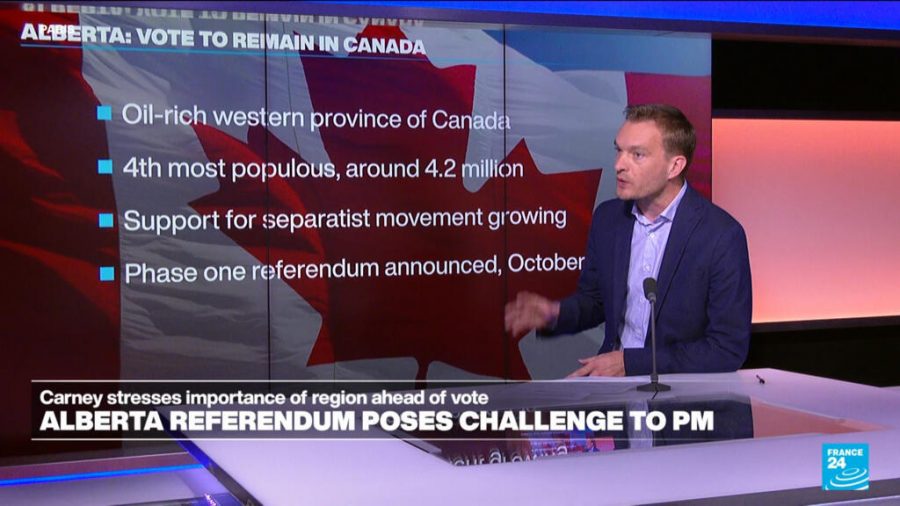
Could Alberta really leave Canada? That once-unthinkable question has rocketed to the forefront of national discourse following Alberta’s announcement of a referendum vote on October 19 to explore a potential path toward independence. While the referendum is non-binding, it has already ignited a political firestorm, dividing public opinion and raising concerns about the future of Canada’s unity.
The Referendum: A Bold Move
Alberta Premier Danielle Smith confirmed the referendum plans earlier this month, stating that it was an opportunity for the province to “assess its position within the federation.” Despite her assurances that she supports Alberta remaining in Canada, the move has been seen by many as a calculated risk to gain leverage in ongoing disputes with the federal government over issues such as energy policy, equalization payments, and resource management.
Prime Minister Mark Carney, in response, has called for national unity, emphasizing that his administration is “working with Alberta on making it better.” The federal government has pledged to address some of the province’s long-standing grievances but cautioned against actions that could destabilize Canada’s political and economic landscape.
Business Leaders and Analysts Warn of Risks
The announcement has sent shockwaves through Alberta’s business community, particularly in the energy sector, which forms the backbone of the provincial economy. Business leaders have voiced concerns that the referendum could introduce uncertainty, deter foreign investment, and harm the province’s economic stability.
Energy analysts warn that even the discussion of independence could hurt Alberta’s standing as Canada’s energy heartland. “The mere prospect of a referendum creates a layer of political risk that investors are keen to avoid,” said a Calgary-based energy consultant.
Separatist Pushback
Interestingly, the move has also drawn criticism from Alberta’s own separatist factions, who argue that the referendum does not go far enough in pursuing independence. Groups advocating for Alberta’s secession have accused Premier Smith of using the issue as a political bargaining chip rather than a genuine attempt to achieve autonomy.
“This is a half-measure,” said a spokesperson for the Alberta Freedom Alliance. “If Alberta is serious about independence, it needs more than a symbolic vote. We need action.”
What’s at Stake?
The October 19 referendum poses significant questions about not just Alberta’s future, but also the broader Canadian federation. While the referendum is non-binding, a strong pro-independence vote could embolden separatist movements in other provinces, such as Quebec, and lead to a deeper fracturing of national unity.
On the other hand, a decisive rejection of independence could strengthen Alberta’s position within Canada, giving Premier Smith the political capital she needs to negotiate better terms for the province on key issues. Either way, the vote is shaping up to be a pivotal moment in Canadian history.
What Happens Next?
As the referendum date approaches, all eyes will be on Alberta to see how its residents respond to this historic question. The outcome, while not legally binding, will undoubtedly set the tone for Alberta’s relationship with Canada for years to come. For now, the nation watches and waits, as the winds of change blow through its energy-rich heartland.