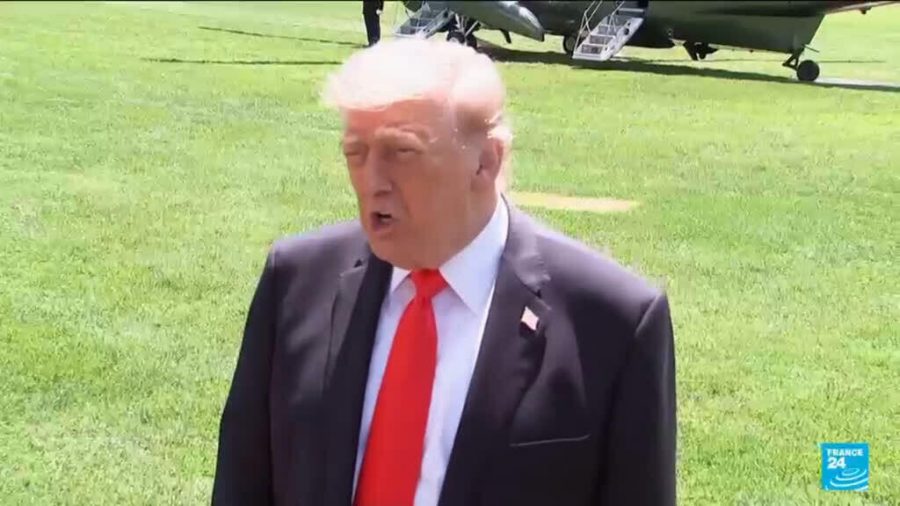
Trump’s Declaration: A Controversial End to Military Action in Iran
In a bold move that has sparked significant debate, President Donald Trump informed Congress that hostilities with Iran have officially “terminated.” This declaration comes on the heels of the expiration of a 60-day deadline set by the War Powers Resolution, which required presidential authorization for the continuation of military action without congressional consent.
The Context of the Conflict
The tension between the United States and Iran escalated dramatically in early 2020, leading to a series of military engagements and retaliatory strikes. The War Powers Resolution, enacted in 1973, was designed to limit the president’s ability to engage in military actions without explicit congressional approval. It requires the president to notify Congress within 48 hours of committing armed forces and to withdraw forces after 60 days unless Congress grants an extension or declares war.
Trump’s Justification
As the 60-day window concluded on Friday, Trump argued that the law was unconstitutional, suggesting that it infringed upon the executive branch’s powers. In a statement to Congress, he asserted that the conflict had already ended due to a ceasefire agreement reached in early April. “The hostilities have terminated,” Trump declared, maintaining that the U.S. had acted in defense of its interests and that the situation was now stabilized.
Reactions from Congress
Trump’s announcement has elicited mixed reactions from lawmakers on Capitol Hill. Some Republicans have supported the president’s stance, emphasizing the need for a decisive approach to national security. However, many Democrats and some Republicans have criticized Trump’s interpretation of the War Powers Resolution, arguing that it undermines the legislative branch’s role in matters of war and peace.
- Representative Adam Schiff, chairman of the House Intelligence Committee, stated, “The president cannot unilaterally declare an end to hostilities when Congress has not authorized military action. This is a dangerous precedent.”
- Senator Tim Kaine echoed similar sentiments, calling for a robust debate on U.S. military involvement in the region.
The Implications of Trump’s Declaration
Trump’s assertion of a ceasefire raises questions about the future of U.S.-Iran relations. While the president maintains that the U.S. has achieved its objectives, analysts warn that the situation remains volatile. The Iranian government has not publicly acknowledged any ceasefire, and tensions continue to simmer in the region.
Looking Ahead
As the political landscape shifts, the implications of Trump’s declaration will likely reverberate through Washington and beyond. The administration’s approach to Iran may shape not only military strategy but also diplomatic relations with allies and adversaries alike.
In the coming weeks, Congress is expected to engage in discussions about the War Powers Resolution and the appropriate checks and balances necessary for military action. Lawmakers are likely to scrutinize the president’s authority and explore potential reforms to ensure that such decisions involve broader consensus.
Conclusion
Trump’s claim that hostilities with Iran have terminated marks a significant moment in U.S. foreign policy, raising critical questions about executive power and the role of Congress in military engagements. As debates unfold, the implications of this declaration will continue to be felt across the political spectrum and in international relations.