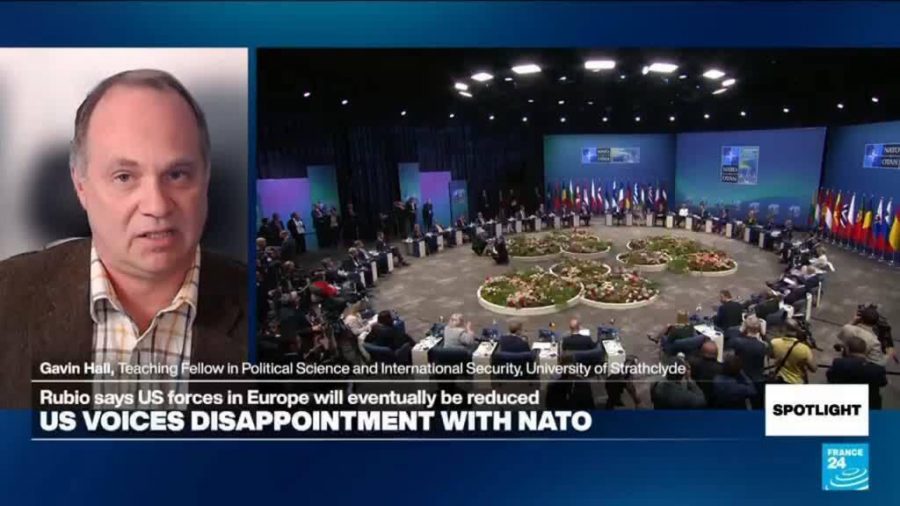
As NATO foreign ministers convene in southern Sweden this week, the alliance faces mounting uncertainty over U.S. support under President Donald Trump. A series of recent developments, including potential troop withdrawals from Europe and tensions over the geopolitical value of Greenland, have raised concerns about the stability of NATO’s collective defense framework.
Fresh Doubts Over Article 5
The cornerstone of NATO is its Article 5 clause, which commits member nations to collective defense in the event of an attack on any one of them. However, President Trump’s administration has repeatedly cast doubt on this principle. Notably, Secretary of State Marco Rubio delivered remarks today that did little to clarify Washington’s stance, further fueling speculation about the U.S. commitment to the alliance.
Experts have expressed alarm at the ambiguity surrounding Article 5. “The lack of a firm commitment erodes trust among allies,” said a senior European diplomat, speaking on the condition of anonymity. “It also emboldens adversaries who may interpret this as a weakening of the alliance.”
Reports of Troop Withdrawals
Adding to the unease are reports that the Trump administration is considering scaling back U.S. troop deployments in Europe. Such a move would mark a significant shift in American foreign policy, as U.S. forces have been a key pillar of NATO’s deterrence strategy since the Cold War. While the Pentagon has not confirmed these plans, sources familiar with the discussions suggest that they remain under active consideration.
“The withdrawal of troops would send the wrong signal at a critical time,” warned retired General James Caldwell, a former NATO commander. “It could embolden adversaries like Russia and undermine the security architecture that has kept Europe stable for decades.”
Greenland and Strategic Tensions
Further complicating matters are the ongoing tensions surrounding Greenland, a strategically significant territory that President Trump once floated the idea of purchasing. While the proposal was dismissed as implausible by Danish officials, it highlighted the administration’s shifting focus toward Arctic dominance and away from traditional European alliances.
“The Greenland episode may seem like a distraction, but it underscores a broader trend,” said Dr. Emily Hart, a geopolitical analyst. “The U.S. appears to be recalibrating its priorities in ways that could leave NATO partners feeling sidelined.”
Is There a Plan B for NATO?
With uncertainty hanging over the alliance, NATO members are reportedly exploring contingency plans in case U.S. support continues to waver. Options on the table include bolstering European defense initiatives and increasing defense spending to compensate for any potential shortfall in American backing.
- Increased EU Defense Cooperation: European nations could deepen their military integration, potentially through frameworks like the Permanent Structured Cooperation (PESCO).
- Independent Defense Spending: NATO allies may accelerate their commitments to spend at least 2% of their GDP on defense, a target many have yet to meet.
- Strategic Partnerships: Strengthening partnerships with non-NATO countries, such as Japan or Australia, could help diversify the alliance’s security network.
While these measures could mitigate some risks, analysts caution that no alternative can fully replace the strategic advantages of a united NATO with strong U.S. participation. “The alliance is only as strong as its weakest link,” Dr. Hart noted. “Losing the U.S. as a reliable partner would fundamentally alter the global security landscape.”
The Road Ahead
As NATO foreign ministers deliberate in Sweden, the stakes could not be higher. The alliance faces challenges not only from external adversaries but also from within, as questions about U.S. reliability persist. For now, NATO’s future remains uncertain, leaving allies to wonder: If the U.S. steps back, what comes next?