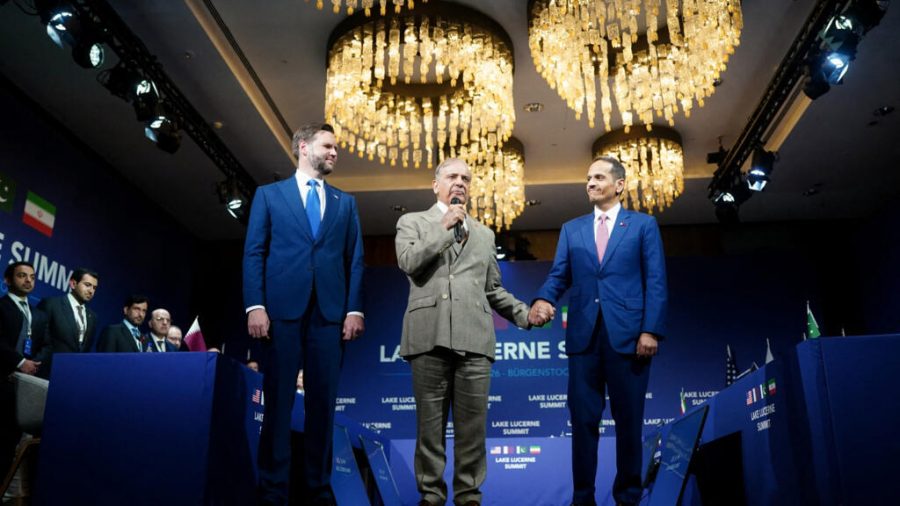
Switzerland Negotiations Enter Critical Phase Amid Renewed Tensions
As negotiations in Switzerland aimed at building upon a recent interim agreement with Iran enter a critical phase, the atmosphere is charged with uncertainty. US Vice President JD Vance expressed optimism on Sunday, suggesting that there might be an opportunity to “turn over a new leaf” with Iran. However, this hopeful sentiment is overshadowed by renewed threats from President Donald Trump regarding Iran and its influence in the region, particularly through Hezbollah and the strategic Strait of Hormuz.
The Context of the Talks
The negotiations in Switzerland follow a week of tentative progress, with both sides seeking to address longstanding issues related to Iran’s nuclear program and regional security. The interim agreement, while a step forward, is fragile and contingent upon the evolving political landscape.
Trump’s Renewed Threats
President Trump has recently intensified his rhetoric against Iran, particularly targeting its support for Hezbollah, the Lebanese militant group that has been a significant player in regional conflicts. His administration’s stance indicates a zero-tolerance approach towards any actions perceived as threatening to US interests or allies in the Middle East.
- Hezbollah’s Role: The Iranian-backed Hezbollah has been a focal point in discussions, with the US accusing the group of destabilizing the region.
- Strait of Hormuz: This critical waterway, through which a significant portion of the world’s oil supply passes, remains a point of contention, with any threats to its security potentially sparking broader conflicts.
Israel’s Position
Adding another layer of complexity to the negotiations is Israel’s refusal to withdraw from a security zone in southern Lebanon. Israeli officials have expressed concerns that any concessions to Iran could embolden Hezbollah and other militant groups, undermining Israel’s security.
Israel’s stance complicates the dynamics of the negotiations, as it seeks to ensure that whatever agreement emerges from Switzerland does not compromise its safety or regional standing. The Israeli government has consistently maintained a hardline approach towards Iran, viewing its nuclear aspirations and regional activities as existential threats.
The Path Forward
As negotiators gather in Switzerland, the challenge remains to bridge the gap between US demands and Iran’s responses. The talks are critical not just for the immediate future of US-Iran relations but also for the broader stability of the Middle East.
Observers are closely monitoring the discussions, aware that any misstep could derail progress and escalate tensions. The stakes are high, and with each party holding firm to its positions, finding common ground may prove to be a daunting task.
Conclusion
In the coming days, negotiators will need to navigate the complex web of international relations, regional security concerns, and domestic pressures. The outcome of these talks in Switzerland could have far-reaching implications not only for Iran and the United States but also for the entire Middle Eastern geopolitical landscape.