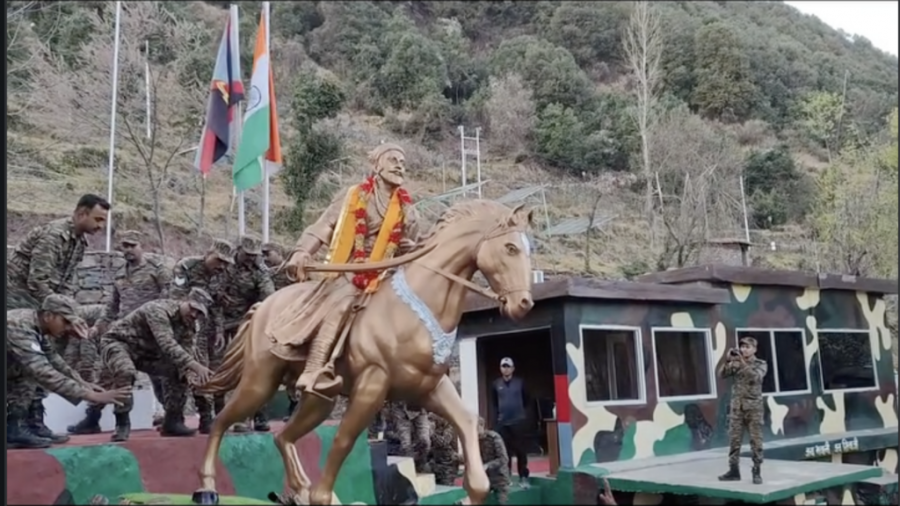
In recent years, a surge of statues honoring the 17th-century Maratha king Shivaji has emerged across several Indian cities, fueled by Hindu nationalist groups who have adopted him as a symbol of resistance against perceived Muslim oppression. These actions represent not only a revival of Shivaji’s legacy but also a troubling trend of increasing intolerance towards India’s Muslim and Christian minorities, particularly since the rise of the Bharatiya Janata Party (BJP) to power over a decade ago.
Shivaji: A Historical Figure Reimagined
Shivaji Bhonsle, the founder of the Maratha Empire, is celebrated for his military prowess and strategic acumen. His reign in the 17th century was marked by battles against the Mughal Empire, which ruled large parts of India at the time. For many in the Hindu nationalist movement, Shivaji’s legacy has been reinterpreted as a beacon of Hindu pride and resistance against a historical narrative they argue has marginalized Hindu contributions to Indian history.
The Symbolic Resurgence
The recent installation of Shivaji statues has taken place in numerous cities, including Mumbai, Pune, and Nagpur. These monuments not only serve as physical representations of Shivaji’s legacy but also as political symbols. Hindu nationalist politicians and organizations, such as the Rashtriya Swayamsevak Sangh (RSS) and the Vishwa Hindu Parishad (VHP), have prominently featured these statues in their campaigns, appealing to a sense of Hindu unity and identity.
A Divisive Narrative
Critics argue that the glorification of Shivaji in this manner fosters a divisive atmosphere in a country characterized by its rich tapestry of religions and cultures. They contend that this movement is part of a broader strategy by the BJP to consolidate Hindu votes by inflaming religious sentiments. The emphasis on Shivaji as a defender against Muslims has been perceived as a direct challenge to India’s secular ethos, which has historically celebrated its diversity.
Minority Communities Under Siege
Since the BJP came to power in 2014, there has been a notable increase in incidents targeting minority communities, particularly Muslims and Christians. Reports of lynching, mob violence, and social ostracization have surged, leading to a climate of fear and repression for these groups. The celebration of figures like Shivaji, intertwined with anti-Muslim rhetoric, has exacerbated these tensions, pushing minority communities further into the margins of society.
Government Support and Political Gains
The BJP’s endorsement of the Shivaji statues and the associated narratives has proven politically advantageous, allowing the party to rally its base while simultaneously undermining opposition parties that advocate for a more inclusive interpretation of Indian identity. The party’s leaders frequently invoke Shivaji’s name at rallies, framing the discourse around national pride and Hindu supremacy.
Reactions from the Muslim and Christian Communities
Muslim and Christian leaders have voiced their concerns over the implications of the growing reverence for Shivaji as an anti-Muslim symbol. They argue that this trend not only undermines the secular fabric of the nation but also threatens the safety and dignity of their communities. Many call for a return to a narrative that embraces India’s pluralism rather than one that divides along religious lines.
The Path Forward
As the debate over Shivaji’s legacy continues to unfold, it raises critical questions about the future of India’s secularism and the treatment of its minority populations. In a nation that prides itself on diversity, the challenge remains to foster dialogue and understanding among its various communities. The resolution of these tensions will require a concerted effort from all sectors of society, including political leaders, activists, and ordinary citizens alike.
In conclusion, while the resurgence of Shivaji’s image as a symbol of Hindu nationalism may resonate with some, it also highlights the urgent need for a reaffirmation of India’s commitment to secularism and respect for all its citizens, regardless of their faith.