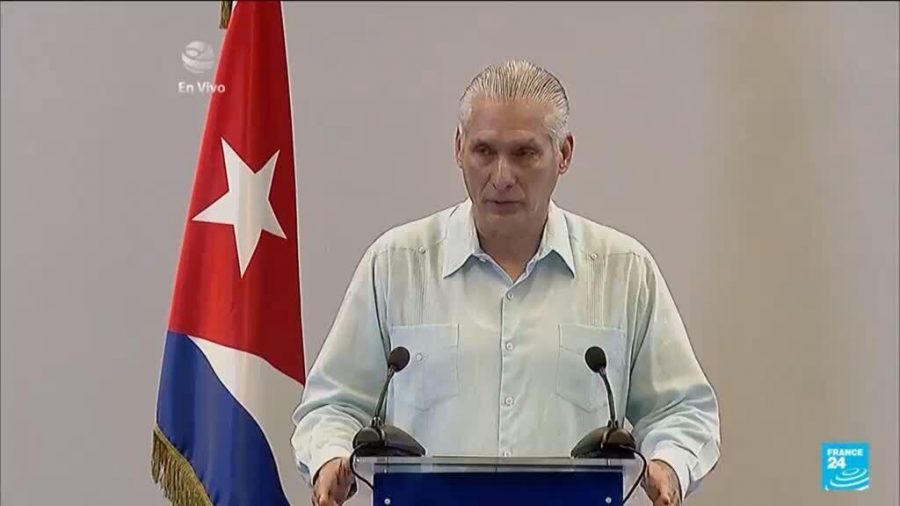
In a powerful statement amid escalating tensions, Cuban President Miguel Díaz-Canel has declared that the island nation reserves the right to defend itself in the event of a military attack by the United States. The warning comes on the heels of recent remarks by former U.S. President Donald Trump, who alluded to the possibility of “taking over” Cuba, further exacerbating the already strained relations between the two countries.
Heightened Sanctions and Rising Hostilities
Relations between the United States and Cuba have continued to sour in recent years, with Washington imposing a series of harsh sanctions targeting Havana’s economy. The sanctions, intensified under the Trump administration, have placed significant strain on the island’s already fragile economy, particularly in the wake of the global pandemic.
In his latest public appearance, Díaz-Canel strongly criticized the U.S. for what he described as “hostile policies” aimed at undermining Cuba’s sovereignty. “Cuba has a legitimate right to defend itself against a military attack,” he declared, adding that any aggressive action from the U.S. would be met with a swift and resolute response.
Trump’s Comments Add Fuel to the Fire
During a recent speech, Trump suggested that the United States should consider “taking over the island,” a comment that has sparked outrage among Cuban officials and citizens alike. While Trump no longer holds office, his remarks have reignited fears of potential intervention, a concern that has loomed over U.S.-Cuba relations for decades.
“These statements are not just rhetoric; they are part of a larger campaign to destabilize our nation,” Díaz-Canel said, emphasizing that Cuba has endured decades of economic blockade and external pressure but remains steadfast in its resolve to protect its independence.
Historical Context of U.S.-Cuba Relations
The fraught relationship between the U.S. and Cuba dates back to the Cold War. Following the Cuban Revolution in 1959, the U.S. imposed a trade embargo that has remained largely in place to this day. While former President Barack Obama made strides toward normalizing relations, including reopening embassies in both countries, those efforts were largely undone by the Trump administration.
The Biden administration has so far maintained many of Trump’s sanctions, citing human rights concerns and political unrest on the island. However, critics argue that these measures have only exacerbated the suffering of ordinary Cubans without achieving any significant political change.
Cuba’s Preparedness for Defense
Despite its economic challenges, Cuba has repeatedly demonstrated its readiness to defend itself against external threats. The Cuban government has a long history of mobilizing its citizenry and military forces in the face of perceived aggression. “Our people are united, disciplined, and prepared to confront any threat to our sovereignty,” Díaz-Canel affirmed.
Cuban officials have also sought to rally international support, condemning what they describe as “imperialist aggression” by the U.S. at global forums like the United Nations. Many nations, including key U.S. allies, have called for an end to the decades-long embargo, arguing that dialogue and diplomacy are better paths forward.
What Lies Ahead?
As tensions continue to rise, the world watches closely to see how the U.S. will respond to Cuba’s latest assertions. Will this lead to further escalation, or could it provide an opportunity for renewed dialogue? For now, the Cuban government remains resolute in its stance, calling for an end to U.S. aggression while preparing to defend its sovereignty at all costs.
In the meantime, ordinary Cubans bear the brunt of these heightened tensions, struggling with economic hardships and uncertainty about what the future holds. The international community, too, faces a pivotal moment, as calls for a more measured approach to U.S.-Cuba relations grow louder.